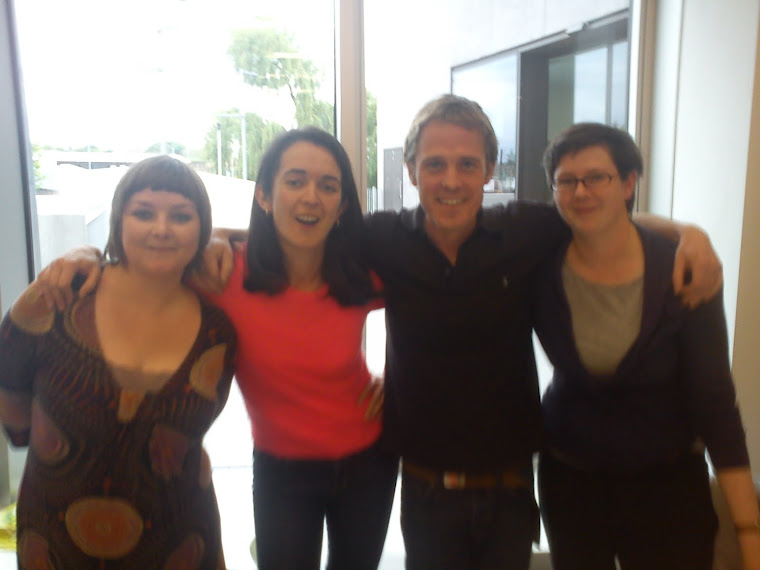
Anna, Emily, Johnny & Susan, Wakefield, 13 June 2012

Friday, 8 February 2013

six questions

 An interesting catch up on Skype for us - I had hoped that the presentation in Leeds would solidfy whst we are doing but unfortunately seems to have dislodged things a bit... In terms of our conversation we discussed publishing online rather than in a publication - better reach and potentially more useful.  We also discussed the possibility of an event as a manifestation - something I hadn't thought of...  It would be interesting but I feel that we need to put a line in the sand, a marker down here, ...  (and then have the possibility of an event)  otherwise things can rumble on...

It seems to me that our six questions are key again - maybe these should be the answerables that we build our manifestation on...  I certainly feel that me and Susan's work try to answer ours - Emily and Anna are less fixed on their outcome at the moment - is it helpful to try to answer your question/s guys?

By having the questions on the homepage, these could introduce  our research for the viewer, aiding their navigation- we could then introduce a bit of context as to why we wish to answer this question... I think this could work...


How do you make the gallery relevant to the community in which its in?

How to build trust into the commissioning process?

What are the connections between what you are doing and how do they work for you?

How to put art in the centre rather than access?

Which direction do you want to face?

How to build a structure that has room for change or  failure?

Mix Tape

We are thinking about a manifestation in the form of a website mix tape: Emily's image of Mixtape from our presentation above.
We just agreed in our skype meeting to share other sites we like for different reasons.
I like soanyway.org.uk as I like how it's quite random.
I really like the Miranda July website because I love the first page.
I quite like the idea of it being a repository for all things participation, but realise that might be too unmanageable, and our conversations seem to suggest it is purely a repository for the content we already have. I will have a think about others that might be good to look at.

Thinking...

What became clear to me through doing our presentation was a need for me to try to draw together the research activity that I engaged in, and the practical changes that have been happening at AirSpace, in relation to the learning from our group project.
Johnny, you have mentioned a few times that the research transcripts may not be where it's at, but for some reason I am still really keen to see them finished, and to write up a paper or something on them.
I do see what you mean though, and in relation to the Common Practice text (thanks for that by the way - still reading it) It would be a good idea to try to think about AirSpace and its value as a small arts organisation, and in particular in relation to the cuts. This idea of needing to adapt to become either more corporate or more philanthropic definitely seems to need to be looked at in more detail. I think we have recognised that we need to almost become more strategically self-serving, which seems the opposite of philanthropy, in order to ensure sustainability (of our own interest in giving so much to the project, without monetary reward.) Maybe this could be an angle for me to look at.
I am trying to pull things together, and think about what to do with the content gathered. I am hoping the conversation we have this afternoon might help with that.
In the mean time, I have added our 4 leadership badges to my collection of small things.

Thursday, 7 February 2013

Tuesday, 29 January 2013

AJE old process


So back from the second residential in Leeds -


.... a very different affair from Wakefield...


Unfortunately Susan couldn't be with us, so SAJE  became three (AJE), with susan voice in attendence via Anna... reactions? All fine, although more critical feedback would be good.  Next step is to review what the mixtape is and how we distribute it.  I was very aware when we were presenting that this wasn't the format it was intended to be viewed in - somehow, in a presentation, it becomes too reduced, no rhythym, too regularr and too reductive...  The joys of a mixtape were always the unexpected, so lets think of:

  • rhythym and pace, 
  • editing (smooth or jarring)
  • volume (shouting or whispering) 
  • placement/distance (close or far)
  • level of completion or production: rough cut or polished
  • Clarity or distortion
  • and of course visual appearance - looking, reading, squinting, remembering, interpreting, translating
Anna - was forwarded this paper today, Value, Measure, Sustainability: Ideas Towards the Future of the Small-Scale Visual Arts Sector,  from Common Practice which I read and which i think will be of particualr relevance to you: (auld Emily was at the symposium which generated the publication) The publication looks at generating "ideas towards the future of the small scale visual arts sector", in relation to sustainability.  Overall a good document, which first problematises the 'ecology' model - i.e. that the fittest will survive, which of course favours those who are more able to survive (which i think and have formulated as being more akin to the 'Cultural Greenhouse' model - who gets brought in over winter...) but also that small orgs function is to serve large orgs... (the hierarchical ladder model)...

Worth a read - although one thing that seems missing to me is any investigation of where the resources come from, and what the money is intended to do...  If space in the symposium/publication was devoted to why we should fund public art in the first place - then maybe we could see how small arts orgs specifically particular serve that goal, which might be one approach within what is referred to as collective strategies...

Sunday, 13 January 2013

thoughts on leadership


My work always starts from the interests, ideas, needs of project participants.  I usually try to work co-operatively, bringing everyone into the decision making, taking all contributions into account.  My thinking was that if I worked hierarchically, participants wouldn’t have a sense of ownership of the project.  What often happened though was a lack of direction.
                                 
Over the past six months, I have reflected on what was successful and unsuccessful, had discussions with participants from past projects and as a result planned a new programme of participatory projects.  I held focus groups to share the ideas and approach for this new programme.  By doing this as presentations, I turned around my usual approach.  Through this I found hierarchical and co-operative are not opposite approaches; presenting a clear idea then enables people to choose to get involved so at times working hierarchically may support co-operation at other stages.

Through this process, I have now written a three year plan with a clear vision and rationale.  I plan to use this to encourage further participation in projects with people with disabilities, artists and arts organisations.  From the Cultural Leadership Reader, the article that resonated most with me was about Connective Leaders: building “a sense of purpose across organisational boundaries, perceived connections between diverse people, ideas and institutions.”

I feel my role as a leader is to articulate a sense of purpose, I would also add to the idea that it’s important to build in check points to ensure the purpose is mutually held; that it reflects the interests off all involved.  Articulating a broad purpose is not the same as controlling all details, the broadness can allows for contributions, for their to be changes and areas of uncertainty.  I have been using the Disney model to separate planning; the vision, planning and evaluation; and found this useful for me and also for participants to know what is being asked.  During a focus group, one participant made a comment, which reassured me about my approach:

“Having a destination creates an archway to look through but as with all creative processes you don’t know how to get there, discussion shapes it.  Being involved in the process with the artist gives a sense of ownership and pride; you feel you’ve created it together.”

I also realised that I’m often trying to fix things when actually the work can set up situations that hint at alternatives without providing solutions.  Reflecting on past projects, I found that work successfully improved access for disabled people, not when advocating for specific changes but when projects brought people together.  This provided opportunities to share and discuss new experiences. 

Part of my leadership is my conviction that art releases the imagination; helps us consider alternative perspectives.  What those will be and what will happen next, you can’t know so you set up contexts and let things happen.  I don’t need to fix, control, document, but briefly bring people together in specific contexts and enjoy the surprises. 

Working on the group project has been really useful to share our practise and ask questions of each other.  Again, it’s not about fixing, or advising, it’s been about supporting each other to reflect and come to new understandings.  I’ve learnt this is a really valuable process and hope there are ways to continue beyond this project.  There has been a lot of sensibility; we made a plan but treated it flexibly by checking what we each needed at the time.  Reflection was aided by the context we had chosen, a wood burning stove, big pots of soup and country walks. 

The question I was asked was “How to put art at the centre rather than access?”  In response I’ve written a short statement that I hope succinctly explains my approach.  As this approach includes working closely with participants, I’ve also collected and presented quotes about experiences.  The statement and reflections on projects have informed a project blog which presents the new programme and an archive of previous work.

A question I asked Anna was, “What are the connections between all the things you do – and how do you make them work for you?”  I realised that the question I asked was relevant to me as I’ve stopped drawing which used to be really important for me.  I’m now using the project to motivate me to pick this up again as a reflective tool.
Wednesday, 2 January 2013

Badges

Having agreed to make a badge for each of us which will underline the part of the presentation where we draw out relevant learning for the wider group we have each chosen a slogan to represent one aspect of our learning.
When it gets to the bit where we share that, we will offer the other groups a chance to select one of our badges, which hopefully will get them thinking about the relevance of our learning to their own experiences on the programme.
Susan's badge says Expert in...and people can add their own text. and comes from Acknowledge and use the expertise of everyone in the room, including yourself.
Emily's says Leadership is responsive and came from understanding about confidence in flexibility.


 Johnny's say equality/quality and mine says 'don' mind the gap - and comes from a realisation through involvment with the course that the job of the leader is not to always fill gaps, but might just be to recognise them.

Sunday, 16 December 2012

Plans for the Presentation

What are the crossover POINTS of our projects?

SUSAN: HOW TO PUT ART AT THE CENTRE RATHER THAN ACCESS? TAKING A LEAD

ANNA : WHAT DIRECTION DO YOU WANT TO FACE IN? WHAT ARE THE CONNECTIONS BETWEEN ALL THE THINGS THAT YOU DO - AND HOW DO YOU MAKE THEM WORK FOR YOU? HOW TO MAKE GALLERY RELEVANT TO THE COMMUNITY IN WHICH IT IS IN? THROUGH DIALOGUE

JOHNNY : HOW TO BUILD A STRUCTURE THAT HAS ROOM FOR CHANGE?

EMILY : HOW CAN THE COMMISSIONING PROCESS GENERATE TRUST FROM THE COMMUNITY WITH WHOM IT IS WORKING? 
 17 JAN 2013

1) INTRODUCTIONS: Who you are individually (30 secs each) and as SAJE (1min) (CHARACTERS) 3 MINS

2) WHAT YOU DID? 4 MINS
SHARED PRACTICES,
LIFE CYCLE,
EXPLORE PERSONAL AREAS OF INTEREST IN RESPECT TO PARTICIPATION,
DID SOME RESEARCH,
CAME TOGETHER TO SHARE RESEARCH AND FINDINGS, FORMED QUESTIONS TO TAKE FURTHER, DECIDED TO DO A MIX TAPE.

3) WHAT HAVE YOU FOUND OUT ABOUT YOUR LEADERSHIP THROUGH YOUR PROJECT? (4 mins each) and as a group (4 mins) (INDIVIDUAL PROJECTS & AS WHOLE = 5 CONSTITUENT PARTS)
BE CONFIDENT THAT LEADERSHIP IS FLEXIBLE RESPONDING TO A SITUATION. TRUST TAKES TIME AND INTENTION.

 4) WHAT HAVE YOU FOUND OUT ABOUT YOUR LEADERSHIP THROUGH YOUR PROJECT? (relevant learning for wider group:

1. Emily: confidence about flexibility
2. Anna: The leader doesn't have to fill the gaps, the leader perhaps recognises the gaps, but allows the things that should fail to fail.
3. Susan: . Acknowledge and use the expertise of everyone in the room, including yourself.
4. Johnny: Value is fluid: there is no definitive value; it depends who is saying it and in what context.

Group learning:
Johnny: We are the leaders amongst our own projects, then with 4 leaders it is interesting to become aware of how you work, and that you don't always have to be in charge or take everyone with you: Recalibration.

5) WHAT ARE YOUR FINDINGS TO DATE?
(MOCK UP MIX TAPE PRESENTATION)

SAJE : MIX TAPE JAN 2013
TO DO: 
SUSAN
INTRODUCTION TO MISSION STATEMENT AND DRAWINGS REFLECTING ON STARTING POINTS FOR PROJECT.

ANNA
TRANSCRIBE INTERVIEWS WRITE UP RESEARCH HIDDEN GARDEN AND GRIZEDALE MEET ANDY AND GLEN TO REVIEW THE THREE QUESTIONS TO LEAD TO MISSION STATEMENT.

JOHNNY
2 PAGE NARRATIVE, DIAGRAMS, SCREENPRINTING.

FOR EMILY TO DO:
PHOTO SAJE : MIX TAPE. TRANSCRIBE INTERVIEW AND SCAN DRAWINGS FROM RESEARCH DAY = SLOGANS. 

Saturday, 15 December 2012

In the cottage


We are in the cottage. A curry is bubbling on the stove, the wood burner is getting through a pile of logs, everyone is in socks and stripey tops. This morning we spent 5 minutes introducing who we are as practitioners and leaders: then 5 minutes introducing our research.
We then attempted to summarise for each other what we were hearing: which Emily pointed out may be problematic, as we may not be communicating what we think we are, and also the summariser will hear the bits they are most interested in. Anyway here is what we had at the end of that process:
Susan's research: A chance to be more strategic rather than reactionary and able to plan to embed art at the centre of what they (Artlink) do, and start there. Question: How do you plan to embed art at the centre of what you do?
Johnny: building a structure in order to understand what happens when one element changes, and considerations around failure. Question: How do you build a structure, which has room for change/failure?
Emily: Realisation that the commissioning process can be intuitive or built on trust. Question: How do you build trust into the process?
Anna: Usefulness of art, and ways to involve participants in the direction of a project. Questions: Which direction do you want to face in? What are the connections between all the things I am doing and how do they work for me? How to make the gallery more relevant to the community its placed in?
We went for lunch at a local pub. We are now making a curry and deciding how to progress: we want to spend the rest of the day finding common links between our research.
Tomorrow we want to decide on a manifestation, and how to approach the group project. Time is going too fast.

Thursday, 6 December 2012

Peak District weekend

Accomodation is booked at Sycamore Barns Friday 14th December til Monday 17th December, leaving by 11am.

Here is some helpful info from Martin at the Barns and his contact is (0)7798 530536:
1. The nearest railway station to Sycamore Farm is Ambergate, which is about 3 miles away. It is easiest is you book a taxi to meet your train and they will bring you up here (it should cost about 6 pounds). We can provide taxi details, if that helps.
2. Wirksworth is our local town and has all the facilities you should need (it is about half an hours walk away – slightly more coming back up the hill!)
3. For four of you I would suggest Knob End for your stay, which is slightly more cosy than Matkins, which has a larger living area.
4. All our cottages have nice wood-burning stoves, and we include as much wood as you need in the price.
5. The whole of Sycamore Farm is primarily heated with wood, from a local pine forest that is being replaced with broad-leaved woodland.
6. The full price for 3 nights from 14th December is £446.25, however as you are intending to arrive by train we are happy to provide it for £400.00. I have pencilled in your booking. If you’d like to secure it we normally ask for a 25% deposit, with the balance due a month before your arrival....


Once we know when we are all arriving we can arrange to meet at Ambergate or the cottage.  Emily arrives about 12 and I will arrive about 1pm.  Emily needs to leave sunday evening, everyone else can stay til monday morning.  Here are details of local Taxi firms:
 
1. Amber Taxis – 01773 836100
2. MJs Taxis – 01629 826060
3. Matlock Taxis - 01629 584195

Thursday, 8 November 2012

Oblique Strategies

Planning a focus group meeting and going back to the course handback for useful guidance on question posing and found some other strategies to shift our thinking....

Oblique Strategies "Change nothing and continue consistently"

using these in planning and maybe at the meeting

Monday, 5 November 2012

conversation and curry


“Never trust a thought that didn’t come by walking.”  - Friedrich Nietzsche

Planning my reserach trips and thinking about the importance of place and activity to the conversation.  I've been looking at a really interesting theatre company, Quarantine, who consider conversation and connections as an ambition of their work.  I'm hoping to join their project No Such Thing, conversations over curry, which they've decided not to document.


I'm also interested in Nic Green's work, such as Slowlow, a reponse to a year of living quietly in the Scottish countryside.


Monday, 15 October 2012

Glasgow Research Trip

I went to Glasgow for three days last week to undertake my research process.
I had planned to met with Celina Jeffery, Manager and editor of Drain magazine, and attend a workshop and talk, but unfortunately these were cancelled last minute. I had set up some other meeting as well with participants in the Clipperton Project expedition to Clipperton Island:
Sculptor Charles Engebretsen and Marine Biologist Kathy Dunlop, as well as an opportunity to see the Clipperton Project Exhibition at the new home of Glasgow Sculpture Studios.
 I had also organised to meet Clementine Sandison, an artist and cultural worker at The Hidden Garden project, about the Glasgow Harvest projects and Culture Kitchen which she is very much leading on.
I now need to have time to transcribe my interviews and write up what I feel happened.
But for now here are the questions which I asked, after looking at Johnny's questions:
1. Can you tell me a bit about yourself and your practice?
2. Can you describe the project for me?
3. How did you get involved?
4. What did you hope to achieve?
5. Have you been able to do that?
6. What did you do?
7. What connections did you make?
8. What helped you/impeded you?
9. Were you able to shape the direction of the project? In what way?
10. What were the results/manifestation? How did you help decide them?
11. How were the results and the project recorded? Did this seem appropriate?
12. Have the relationships continued?
13. What happens next? Where does it go?
14. Is what happened useful? Who for?
15. Has involvement impacted on you - in your life or the way that you work?

Sunday, 14 October 2012

discussion themes


 I'm starting to focus my research and will post more as ideas develop and as I identify artists for discusisons.  At this stage this is what I'm thinking about.

Questions:

  • In what ways do the arts promote change?
  • What are the ethical implications of this? – whose change? what change?
  • How can processes of change be documented, recorded and presented? - consider that changes may be; intended or unintended, within a project, as a result of it or beyond the immediate activity.
  • In what ways can project documentation support participation and change?
Approach:
Draw comparisons between theories of education and socially engaged practise to understand these processes and in order to recognise and begin to take full advantage of my own skills. 

Test developing understandings through discussions with artists about their practise.

Reflect on my own approach to project design and development, work with artists and sharing of project stories.


Working Ideas:

Artists lead through practise by enabling us to see the world differently.

Artists lead without knowing the answers, valuing risk and uncertainty
"Creating without preconceptions means fostering conditions rather than producing the object or situation"

Its not necessarily about promoting an agenda of change but rather acknowledging
“the ability of every individual touched by the work to think in new ways.”