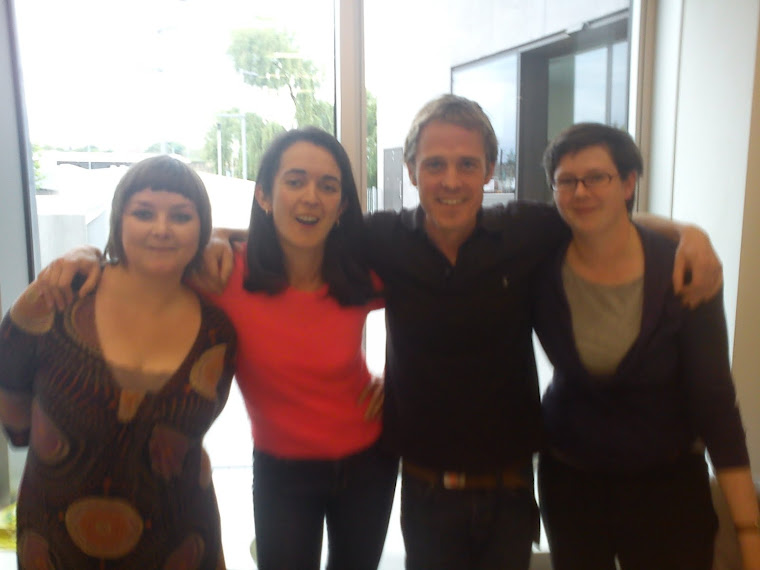
Anna, Emily, Johnny & Susan, Wakefield, 13 June 2012

Sunday, 16 December 2012

Plans for the Presentation

What are the crossover POINTS of our projects?

SUSAN: HOW TO PUT ART AT THE CENTRE RATHER THAN ACCESS? TAKING A LEAD

ANNA : WHAT DIRECTION DO YOU WANT TO FACE IN? WHAT ARE THE CONNECTIONS BETWEEN ALL THE THINGS THAT YOU DO - AND HOW DO YOU MAKE THEM WORK FOR YOU? HOW TO MAKE GALLERY RELEVANT TO THE COMMUNITY IN WHICH IT IS IN? THROUGH DIALOGUE

JOHNNY : HOW TO BUILD A STRUCTURE THAT HAS ROOM FOR CHANGE?

EMILY : HOW CAN THE COMMISSIONING PROCESS GENERATE TRUST FROM THE COMMUNITY WITH WHOM IT IS WORKING? 
 17 JAN 2013

1) INTRODUCTIONS: Who you are individually (30 secs each) and as SAJE (1min) (CHARACTERS) 3 MINS

2) WHAT YOU DID? 4 MINS
SHARED PRACTICES,
LIFE CYCLE,
EXPLORE PERSONAL AREAS OF INTEREST IN RESPECT TO PARTICIPATION,
DID SOME RESEARCH,
CAME TOGETHER TO SHARE RESEARCH AND FINDINGS, FORMED QUESTIONS TO TAKE FURTHER, DECIDED TO DO A MIX TAPE.

3) WHAT HAVE YOU FOUND OUT ABOUT YOUR LEADERSHIP THROUGH YOUR PROJECT? (4 mins each) and as a group (4 mins) (INDIVIDUAL PROJECTS & AS WHOLE = 5 CONSTITUENT PARTS)
BE CONFIDENT THAT LEADERSHIP IS FLEXIBLE RESPONDING TO A SITUATION. TRUST TAKES TIME AND INTENTION.

 4) WHAT HAVE YOU FOUND OUT ABOUT YOUR LEADERSHIP THROUGH YOUR PROJECT? (relevant learning for wider group:

1. Emily: confidence about flexibility
2. Anna: The leader doesn't have to fill the gaps, the leader perhaps recognises the gaps, but allows the things that should fail to fail.
3. Susan: . Acknowledge and use the expertise of everyone in the room, including yourself.
4. Johnny: Value is fluid: there is no definitive value; it depends who is saying it and in what context.

Group learning:
Johnny: We are the leaders amongst our own projects, then with 4 leaders it is interesting to become aware of how you work, and that you don't always have to be in charge or take everyone with you: Recalibration.

5) WHAT ARE YOUR FINDINGS TO DATE?
(MOCK UP MIX TAPE PRESENTATION)

SAJE : MIX TAPE JAN 2013
TO DO: 
SUSAN
INTRODUCTION TO MISSION STATEMENT AND DRAWINGS REFLECTING ON STARTING POINTS FOR PROJECT.

ANNA
TRANSCRIBE INTERVIEWS WRITE UP RESEARCH HIDDEN GARDEN AND GRIZEDALE MEET ANDY AND GLEN TO REVIEW THE THREE QUESTIONS TO LEAD TO MISSION STATEMENT.

JOHNNY
2 PAGE NARRATIVE, DIAGRAMS, SCREENPRINTING.

FOR EMILY TO DO:
PHOTO SAJE : MIX TAPE. TRANSCRIBE INTERVIEW AND SCAN DRAWINGS FROM RESEARCH DAY = SLOGANS. 

Saturday, 15 December 2012

In the cottage


We are in the cottage. A curry is bubbling on the stove, the wood burner is getting through a pile of logs, everyone is in socks and stripey tops. This morning we spent 5 minutes introducing who we are as practitioners and leaders: then 5 minutes introducing our research.
We then attempted to summarise for each other what we were hearing: which Emily pointed out may be problematic, as we may not be communicating what we think we are, and also the summariser will hear the bits they are most interested in. Anyway here is what we had at the end of that process:
Susan's research: A chance to be more strategic rather than reactionary and able to plan to embed art at the centre of what they (Artlink) do, and start there. Question: How do you plan to embed art at the centre of what you do?
Johnny: building a structure in order to understand what happens when one element changes, and considerations around failure. Question: How do you build a structure, which has room for change/failure?
Emily: Realisation that the commissioning process can be intuitive or built on trust. Question: How do you build trust into the process?
Anna: Usefulness of art, and ways to involve participants in the direction of a project. Questions: Which direction do you want to face in? What are the connections between all the things I am doing and how do they work for me? How to make the gallery more relevant to the community its placed in?
We went for lunch at a local pub. We are now making a curry and deciding how to progress: we want to spend the rest of the day finding common links between our research.
Tomorrow we want to decide on a manifestation, and how to approach the group project. Time is going too fast.

Thursday, 6 December 2012

Peak District weekend

Accomodation is booked at Sycamore Barns Friday 14th December til Monday 17th December, leaving by 11am.

Here is some helpful info from Martin at the Barns and his contact is (0)7798 530536:
1. The nearest railway station to Sycamore Farm is Ambergate, which is about 3 miles away. It is easiest is you book a taxi to meet your train and they will bring you up here (it should cost about 6 pounds). We can provide taxi details, if that helps.
2. Wirksworth is our local town and has all the facilities you should need (it is about half an hours walk away – slightly more coming back up the hill!)
3. For four of you I would suggest Knob End for your stay, which is slightly more cosy than Matkins, which has a larger living area.
4. All our cottages have nice wood-burning stoves, and we include as much wood as you need in the price.
5. The whole of Sycamore Farm is primarily heated with wood, from a local pine forest that is being replaced with broad-leaved woodland.
6. The full price for 3 nights from 14th December is £446.25, however as you are intending to arrive by train we are happy to provide it for £400.00. I have pencilled in your booking. If you’d like to secure it we normally ask for a 25% deposit, with the balance due a month before your arrival....


Once we know when we are all arriving we can arrange to meet at Ambergate or the cottage.  Emily arrives about 12 and I will arrive about 1pm.  Emily needs to leave sunday evening, everyone else can stay til monday morning.  Here are details of local Taxi firms:
 
1. Amber Taxis – 01773 836100
2. MJs Taxis – 01629 826060
3. Matlock Taxis - 01629 584195

Thursday, 8 November 2012

Oblique Strategies

Planning a focus group meeting and going back to the course handback for useful guidance on question posing and found some other strategies to shift our thinking....

Oblique Strategies "Change nothing and continue consistently"

using these in planning and maybe at the meeting

Monday, 5 November 2012

conversation and curry


“Never trust a thought that didn’t come by walking.”  - Friedrich Nietzsche

Planning my reserach trips and thinking about the importance of place and activity to the conversation.  I've been looking at a really interesting theatre company, Quarantine, who consider conversation and connections as an ambition of their work.  I'm hoping to join their project No Such Thing, conversations over curry, which they've decided not to document.


I'm also interested in Nic Green's work, such as Slowlow, a reponse to a year of living quietly in the Scottish countryside.


Monday, 15 October 2012

Glasgow Research Trip

I went to Glasgow for three days last week to undertake my research process.
I had planned to met with Celina Jeffery, Manager and editor of Drain magazine, and attend a workshop and talk, but unfortunately these were cancelled last minute. I had set up some other meeting as well with participants in the Clipperton Project expedition to Clipperton Island:
Sculptor Charles Engebretsen and Marine Biologist Kathy Dunlop, as well as an opportunity to see the Clipperton Project Exhibition at the new home of Glasgow Sculpture Studios.
 I had also organised to meet Clementine Sandison, an artist and cultural worker at The Hidden Garden project, about the Glasgow Harvest projects and Culture Kitchen which she is very much leading on.
I now need to have time to transcribe my interviews and write up what I feel happened.
But for now here are the questions which I asked, after looking at Johnny's questions:
1. Can you tell me a bit about yourself and your practice?
2. Can you describe the project for me?
3. How did you get involved?
4. What did you hope to achieve?
5. Have you been able to do that?
6. What did you do?
7. What connections did you make?
8. What helped you/impeded you?
9. Were you able to shape the direction of the project? In what way?
10. What were the results/manifestation? How did you help decide them?
11. How were the results and the project recorded? Did this seem appropriate?
12. Have the relationships continued?
13. What happens next? Where does it go?
14. Is what happened useful? Who for?
15. Has involvement impacted on you - in your life or the way that you work?

Sunday, 14 October 2012

discussion themes


 I'm starting to focus my research and will post more as ideas develop and as I identify artists for discusisons.  At this stage this is what I'm thinking about.

Questions:

  • In what ways do the arts promote change?
  • What are the ethical implications of this? – whose change? what change?
  • How can processes of change be documented, recorded and presented? - consider that changes may be; intended or unintended, within a project, as a result of it or beyond the immediate activity.
  • In what ways can project documentation support participation and change?
Approach:
Draw comparisons between theories of education and socially engaged practise to understand these processes and in order to recognise and begin to take full advantage of my own skills. 

Test developing understandings through discussions with artists about their practise.

Reflect on my own approach to project design and development, work with artists and sharing of project stories.


Working Ideas:

Artists lead through practise by enabling us to see the world differently.

Artists lead without knowing the answers, valuing risk and uncertainty
"Creating without preconceptions means fostering conditions rather than producing the object or situation"

Its not necessarily about promoting an agenda of change but rather acknowledging
“the ability of every individual touched by the work to think in new ways.”

Sunday, 30 September 2012

Inspiration


'I went from being an artist who makes things, to being an artist who makes things happen.'
                                                                                          -Jeremy Deller

Thursday, 27 September 2012

Fwd: Project questions


Begin forwarded message:

From: Johnny Gailey <johnnygailey@blueyonder.co.uk>
Date: 27 September 2012 16:46:02 GMT+01:00
To: "johnnygailey.saje@blogger.co.uk" <johnnygailey.saje@blogger.co.uk>
Subject: Project questions

Can you tell me a little bit about yourself?
And a little bit about the project? 
Do you recognise this model?
Where you do situate yourself on relation to this project?
What motivated you to be part of this project?
Anything else?
What did you want to achieve/ do?
Where you able to do that?
What did you do?
What helped you?
What impeded you?
Where you creatively involved? How?
Was there a manifestation?
Did you shape that manifestation? How?
What satisfied you about your involvement?
What didn't satisfy you about your involvement?
Where does the art/ manifestation go now? 
The aftermath? Within the project?
The aftermath ? Beyond the project?

Monday, 24 September 2012

Art which is Useful to Society:

Socially engaged practices have been around a long time, and a few years back when arts funding was relatively easy to come by, perhaps due to government regeneration schemes, as well as community development funds charged with engaging the public, it seemed there was a glut of artists working in this way. It could be argued that much of the work done was unsustainable, did nothing for community development, and in many cases was quite bad art.
Then came the Tories. Then came the Cuts.
Times have changed.
There is a fairly new swathe of 'socially-engaged' projects, which aim to support development in communities, working with local people to change the world around them, even if in a small way. Almost every city seems to have an arts group working around ideas of sustainability, and mixing ideas of food sustainability with art. Growing spaces on interim sites are springing up all over - indeed, we have been developing an outdoor Yard space for a few years now at AirSpace Gallery. Hoping to contribute to the local ecology, feeding the birds, but recently working with one of our studio artists to explore using small yard spaces as potential sites for urban food growing. We applied for local community funding, as our idea was to develop our outdoor space as an outdoor classroom, to demonstrate how even a relatively small yard can yield a good crop of food. In the space we want to demonstrate vertical growing techniques, propagation and maintenance, also hoping that the space will become a resource and escape space for people working in the area. We were unsuccessful in the funding bid, the feedback during the interview and afterwards was that they felt we just wanted someone else to pay for our garden, and that the project would not be beneficial to the community or represent value for money.  The question I wanted to raise, but didn't was that I am a member of the community, as are many of the other artists involved in the project - don't we count? But actually, our motives were not purely selfish, as suggested, we really did want to demonstrate something to people here.

For the SAJE project I wish to explore exactly what it means to be a socially-engaged artist. After the conversation with Alistair Hudson from Grizedale, where he described what they do as 'art which aims to be useful to society' I have been thinking a lot about the issues that this notion raises.  What does it mean for other art, that does not aim to be useful to society? Is that art therefore flighty, self-indulgent, unuseful? A lot of the time it seems that this art work which is described as useful, often does not look like art - the engaged public or community member has no idea that a trojan horse has rumbled in. If it is not recognisable to the participant as art, is that important? Is it still art? Where does aesthetic come into the conversation? Why are artists doing this work and not councils and governments? Can artists really be trusted? Aren't we all just out for what we can get, or are we truly socially engaged? What are our motives?

Maybe this breed of artist doesn't want to condone a world obsessed with the commodification of everything - including culture. Artists are setting up alternative economies; creative industries as an alternative to throw-away, buy now pay later cultures. Artists are calling for citizen activism, creating a difference in the places they live and work. Artists want to work on longer term, meaningful projects, they don't want to be used as social sticking plaster or box-ticking consultants anymore. These artists are not interested in creating heavy lumps of metal to litter the streets in the name of public art. Artists can draw attention to resources that have been overlooked, and find creative uses for them. Artists can demonstrate alternative ways of being and living. Artists can create interruptions which suggest new routes. Artists are doing all this already. The big society is another big gimmick, to avoid responsibility, not to nurture it.
A lot can be learnt from these projects, but how are they being documented, discussed and advocated for?

The projects I want to look at for SAJE look to be doing a good job of engaging the public in cultural activity - whether that be growing, making or selling. I would like to explore what the results looks like. How the participants feel about it. What the organisers/artists aim to achieve through the activity. And still considering the exit strategy - how do you hand this back, or ensure it continues?
In many ways a question about what the art looks like may be irrelevant. If we are creating situations where the community become cultural producers, do we still need to keep an eye on aesthetic quality, or is that no longer an issue? A painting might be beautiful - and might make people feel better about life, and perhaps that is where the crossover is? Locating 'the art' in the projects that I intend to look at might be a dead end.
While carrying out the research, I also want to explore the importance of dialogues within work of this nature, one of the soft outcomes of projects like this is that they almost always involve interaction between artist and community member or community member and community member - something which was at risk of dying out in public life. I intend to test walking as a consultation tool. I will ask interviewees to take me on a one hour walk around an area where the project has taken place, or somewhere else if the area is not available. Then I will ask questions while we are walking. I will also give the participant a camera and ask them to photograph on the way.
I am going to Glasgow in October: I am still organising my visit;
I aim to go on a walk with 2 participants from The Clipperton Project, plus enter into an email conversation with Alex Kearney (director). I am meeting up with Celina Jeffrey while there too and going to her workshop looking at 'Searching' as a social and political strategy.
I aim to go on a walk with an organiser from one of NVA's Sow And Grow Everywhere project, (The Concrete Garden?) as well as a member of the community who is using one of the growing spaces.
I would also love to return to Grizedale, and go on a walk around Coniston with one of the Grizedale Arts workers, as well as one or two of the participants in one of their projects, but I don't know that I will have time to do that as well.
Thursday, 6 September 2012

Useful Art

I have been thinking a lot about the research we are all doing, and keep shifting my perspective on what it is I want to find out.
My ideas were around sustainability and survival - something urgent about the 'point' of art projects keeps swimming about in my periphery. What do art projects do or what are they for? I am interested in looking at projects which have been called 'socially-engaged' and what that might mean.
A recent visit to Grizedale Arts - at Lawson Park got me thinking...
Grizedale Arts have been around since the 70s - but for much of that time have been building up a programme of sculptural works in the forest.
From what I understand this continued until Adam Sutherland took over as Director - bringing in a new direction. The sculpture programme in the forest still exists (and featured recently on Country File!) and has a curator, but Grizedale Arts has taken a new direction. I asked Alistair Hudson if he could describe the difference in approach that they take now, and he said something along the lines of ' we want to work on projects that are useful to society.'
I find this idea fascinating - and hope to explore it through the research we do for SAJE. What is art that useful to society - what does it look like - how do the participants feel about it? Some of the projects that Grizedale now do are not recognised by the people involved as being art.While in Coniston, I visited their Honest Shop, a shop with no shop keeper, where local people can sell their wares (making a glut of vegetables into profit, or an enjoyment of knitting teddy bears into a bit of extra christmas money.) I was speaking to one of the ladies running a stall in the Coniston institute (one of Grizedale's projects.) I asked her if this was an art project, and she wasn't sure, but she thought it was a very good thing for Coniston anyway.
So, in selecting which projects to look into for my research: I think I am moving towards projects which might be described as 'Useful To Society' or Socially Engaged. I would like to look at NVA's Sow and Grow Everywhere project, and The Clipperton Project (currently in Glasgow) as well as perhaps revisiting Grizedale, and speaking to the youthclub, or some of the regular contributors to their Honest Shop.
I would still like to explore the idea of walking as a participatory tool, or as a tool for aiding good conversation - so perhaps the request could be for the people I interview to take me on a tour of the area where the project takes place - demonstrating the 'usefulness' in geographic locations.

Thursday, 26 July 2012

leadership learning

How will the project contribute to my learning about leadership?
In my practise managing participatory projects, I have often try to remain open to the contributions of all involved.  However, this has led to some confusion and a lack of direction.
To develop my leadership skills, i have been working to articulate a clear vision for a new direction.  Within this I have been reflecting on when to ask for contributions and what specifically this is achieving.
The journey I propose to undertake is an opportunity to put this into practise; I have identified a particular set of questions and designed a situaion to collect responses.  The group meeting provides an opportunity and motivation to continue to reflect on these themes and extend my learning from the others experiences.

Thursday, 12 July 2012

Our Proposal


The SAJE project is a collaborative piece of research, undertaken by four attendees at the Extend programme: Susan Humble, Anna Francis,  Johnny Gailey  and Emily Druiff.  In Wakefield the group each discussed what they wanted to achieve, this has been refined through our conversations and we now have: 
What we each want to come away with: 
Anna:
I intend to research issues around sustainability and survival by exploring how artists can work with communities, and whether participants become co-producers. Questions to consider: What sort of exit strategies do the artists/organisations have in place in order to see the project continuing without them? Where is the artistic experience or object located within projects of this kind? I propose to visit 2 NVA projects: The Hidden Gardens in Pollokshields, 2003 to today and SAGE (Sow and Grow Everywhere.)
Susan:
In relation to a current walking project with visually impaired participants, I will reflect on the way I document and share our experiences.  I am concerned that current methods are focused on funding and justification.  I am interested to explore ways documentation could further participation by existing and new audiences.

I aim to shift my thinking around this by inviting the participants on a journey to meet a project, ask questions and crucially document this process.  The form of documentation and discussions we have on the train journey will inform the way I represent and share future events. 

I hope this will deepen the involvement of participants and explore ways to represent experiences by inverting usual leadership roles.
Emily:
I will look at the process of commissioning socially engaged practice within two organisations: Grizedale Arts and Peckham Space. I will do this by inviting people who have worked within each organisations with different roles including artist, participant and commissioner. Each member of the group will be invited  to engage in conversation over a durational meeting with the responsibility to document the conversations from the variety of perspectives involved. This documentation will then be fed back to the group for consolidation in a document or format to be confirmed.
Johnny:
I propose to visit two projects based in Yorkshire:
The SeaSwim project in Scarborough: http://www.imoveand.com/seaswim/
and the National Education Archive, held at Yorkshire Sculpture Park: http://www.ysp.co.uk/page/national-arts-education-archive/es

My primary area of interest is to investigate what happens to the artwork after the project - the stewardship - of what is produced, and whether if we are aiming through our participatory practice to foster a 'democracy of making' , we equally have to foster 'a democracy of looking'.

Key words
·         Survival
·         Sustained
·         Communities
·         Communication
·         Commissioning
·         Benefits
·         Authenticity
·         Honesty
·         Value
·         Permission

Over the past two months the group have swapped practices, publications, ideas and have put together the following proposal:
Proposal: 
Milestones
July                 Proposal
Aug-sept         Personal projects
Oct/nov          Group meeting to share findings
Dec                Compile outcomes
Jan                  Presentation

Our  proposal is to focus on the key principles which we believe underpin participatory artwork.  This focus would hold it all together while allowing room for individual exploration.  Each of us would embark on some research, looking at two participatory projects each, to provide the content for a discussion, which will then be brought together over a weekend to discuss experiences and findings.  This open-ended method would enable us to explore our own areas of interest in a way relevant to our work. The different areas of interest, expertise and practice will make the outcomes very rich. The project will draw on the experiences within the group to understand experiences of participation in meaningful ways and from multiple perspectives.  This will create opportunities for learning within the group as well as presenting heterogeneous outcomes that does not treat one form of practise as superior.

The project aims to present imaginative ways to connect with participatory practice.  The focus on environment and context potentially has important implications for ways we plan, conduct and evaluate educational and participatory projects.  We will propose new approaches to who we involve in these processes and whether this can have revitalising and generative effects on our thinking. As an extension of that, within the research carried out by the group the context for conversations around participation will be carefully considered, as each researcher seeks to create an intimate space for the discussion around the participatory projects explored. Through the methodology of creating an intimate space, each researcher will be aware of and note the context and environment,, and who takes the lead in the gathering/discussion.  This will add a layer to our research which will be further discussed at the weekend gathering.

Underlying principles or areas of interest will need to be strong for this to hold together.  Initial discussions have centred on:

  1. What do we mean by ‘meaningful’ participation?
  2. Where is the value located?
  3. What motives do different stakeholders have for being involved in the process, at different stages of the project?
  4. What is the importance of environment and context to participation
  5. How do we authentically and honestly represent experiences
The project will seek to generate and understand social exchanges as part of meaningful participation in the arts. 

Each participant will have the opportunity to reflect on and extend their own practise through a research period.  Each researcher shall investigate their primary area of interest, however they will also have the three others' interests (as secondary interests) to investigate. This will generate rich content for a group sharing event.  A central focus of the project is exploring authentic and appropriate ways to represent experiences.  As this forms a part of the explorations and multiple perspectives, it is impossible at this stage to predict the method of documentation and outcome.

We do wish though to find a form that is appropriate – if we are seeking in our projects to foster ‘ a democracy of making’, we also must seek to create a ‘democracy of looking’.  The coherence of the project will be maintained by a common aesthetic as outlined by Bourriaud: “we must judge that domain of exchanges on the basis of its aesthetic criteria, or in other words by analysing the coherence of its form and then the symbolic value of the world it represents”.  The principles of participation and representation will be both employed and interrogated across all projects.

In gathering the research, we will pay particular attention to methods of retrieval – noting who is ‘leading’ the conversation and whether we can coach responses rather than being directive.  Through the process of planning, negotiating, researching and presenting, each participant will reflect their developing understanding of leadership.  This will be layered with reflection on ongoing professional development through participation in the Extend programme.

Step in and withdraw

Ahead of today's skype meeting I am trying to draw together the area of participation that I would be interested in exploring. Something I have grappled with a bit in my own practice is that when collaborating with someone, or making works which perhaps have this participatory (socially engaged?) aspect to them I worry that people don't always understand what I do.
The recent work I did in Harlech - where I worked with the local landlady to make a brochure as she was fed up that there wasn't one: some of the artists on the residency thought I was a graphic designer - and they were quite dismissive of what I was doing as a result. I suppose the point for me was around motives: If I am working with a local landlady to make a brochure for her town, it is not because I like making brochures, or because I think my brochure should be THE brochure for Harlech - but rather to say this is a possibility, this is a potential thing you can do to deal with the thing that hacks you off. Similar with the Bandstand from Common Ground: I was not interested in being the person to organise musical events on the local bandstand: I wanted to draw attention to the fact that no music events ever happened on the bandstand since 1997 when I moved here. So I organised for a brass band to come and play, put up bunting and flower baskets, organised for chairs for the public to sit on and gave out ice creams in exchange for people's feedback (this was just one art work of 18 in the park that weekend - see more detail here). People said to me, this is great, you should do it every week in the summer: and I said - no, you should do it every week in the summer. Since then Park Live! takes place: where various local bands, singers and other acts come and do performances on the bandstand. Who knows if it is a direct result of my concert?
There are other projects like this that I could mention: I suppose I am interested in a few things here: other artists can be critical of the activity, saying it is not art - what makes it art? What is my responsibility to the collaborator/participant? When do I step back and let the thing go? Is it enough to draw attention to the gap, or should I suggest a possible solution, or should I solve the problem? I am not a social worker, or a guardian angel - and don't want my work to be labelled as do-gooding. When working with others, like the landlady - is she a co-producer? In the long run, what is the value of the activity?
I think for our research i would like to explore a couple of projects which are labelled as socially-engaged. In particular looking at when the artist/organisation steps back and lets the public/community get on with it. How is that exit strategy managed? How does the community feel about it? I think NVA's Hidden Garden's project is one that has fascinated me for some time, and so I would really like to look at the history of it, and how it has managed to survive for such a long time - and thrive.
I would also be interested in looking at another NVA project: The Invisible College, as this is quite new, and I would be interested in seeing how they are going about involving people at this stage, and what it is they see as the 'art' in the activity.

Lifecycle


Link to The lifecycle of a project